

August WASDE Analysis


The August WASDE answered the season’s biggest question: the first survey-based corn yield came in at 180.7 bushels per acre, down 2.3 from July’s weather-adjusted trend. A revision to planted acres helped offset most of the gap, and production still edged higher.
The supply cuts came from demand.
USDA raised corn exports 75 million bushels in both crop years, dropped new-crop carryout 92 million below the average analyst guess, and took old-crop stocks below the lowest estimate in the Bloomberg survey. The corn season-average price forecast rose a dime to $4.50. We remain in Stage #1 of the Golden Grain Cycle, with prices near cost of production, and demand keeps eating through the cushion.
CORN
NASS’s first objective yield survey put corn at 180.7 bushels per acre, 2.3 below the July projection. Harvested area rose 1.2 million acres to 88.6 million, though, so production actually ticked up 13 million bushels to 16,013 million. If realized, this would be the second-largest U.S. corn harvest on record, behind only last year’s 17.0 billion.
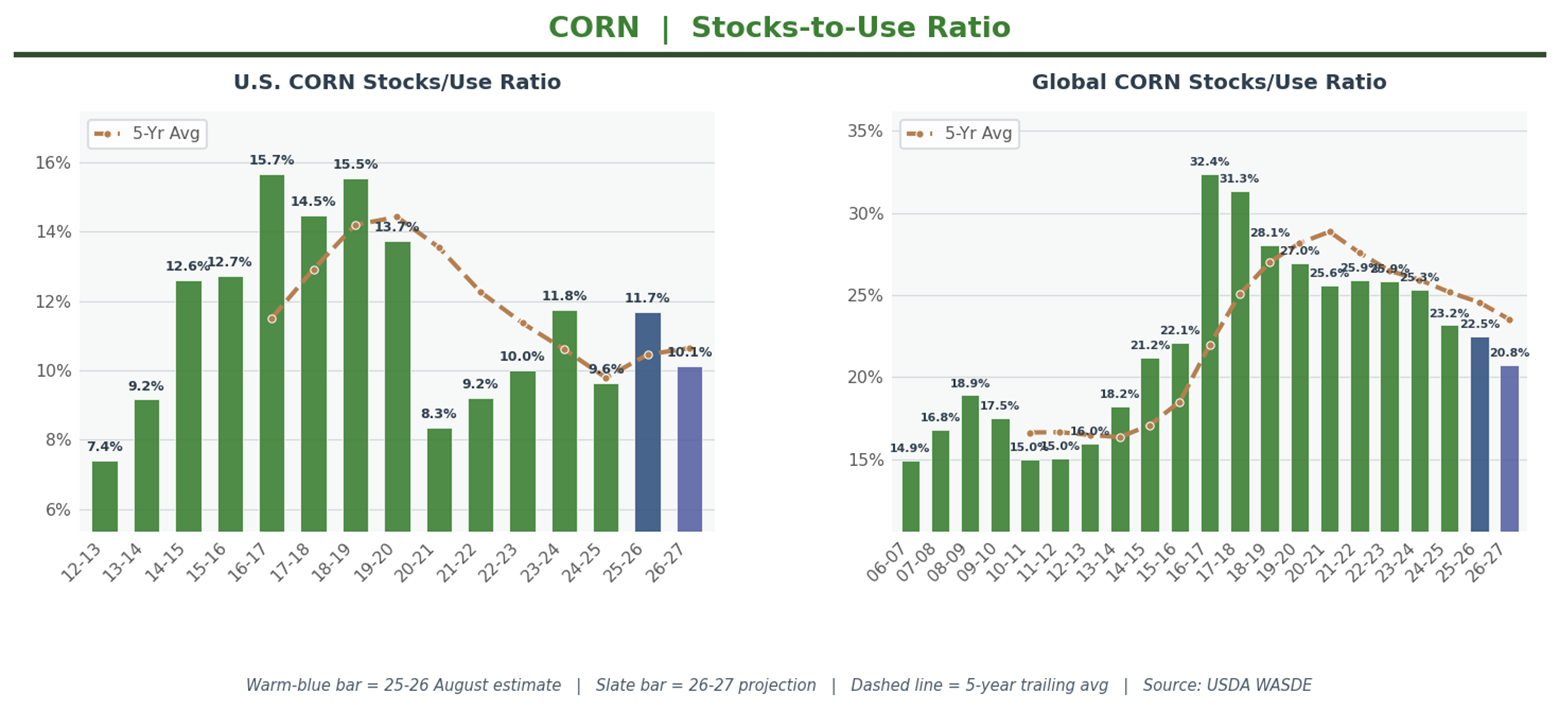
Demand did the tightening. USDA raised 2026/27 exports 75 million bushels to 3,275 million on stronger global demand and constrained Ukrainian shipments, and a smaller carry-in did the rest. Ending stocks fell 137 million bushels to 1,653 million, 92 below the 1,745 million analyst average. The 2026/27 season-average price forecast rose $0.10 to $4.50 per bushel. New-crop stocks-to-use drops to 10.1% from 11.0% in July.
The old-crop book tightened as well.
USDA raised 2025/26 exports 75 million bushels to 3,400 million, cutting ending stocks to 1,945 million. Analysts averaged 1,997, and the lowest guess in the Bloomberg survey was 1,948; USDA came in under all 25 of those surveyed. The 2025/26 season-average price forecast held at $4.15 per bushel. Old-crop stocks-to-use now sits at 11.7%, down from 12.2% last month.
World 2026/27 ending stocks slipped 0.6 mmt to 274.66 million metric tons. Extreme heat and dryness cut EU yield prospects again, while Russia, Ukraine, and Zambia got production increases. The trade mix shifted toward the United States, with U.S. exports raised while Ukraine and the EU were cut. World new-crop stocks-to-use eases to 20.8%, still pointing toward the tightest global corn carryout in over a decade.
SOYBEANS
Soybeans found more acres too. Harvested area rose 1.4 million acres to 85.8 million on higher acreage in Missouri, Mississippi, and Minnesota, while the first survey-based yield came in at 52.7 bushels per acre, 0.3 below both last month’s projection and last year’s record. Production rose 44 million bushels to 4,519 million.
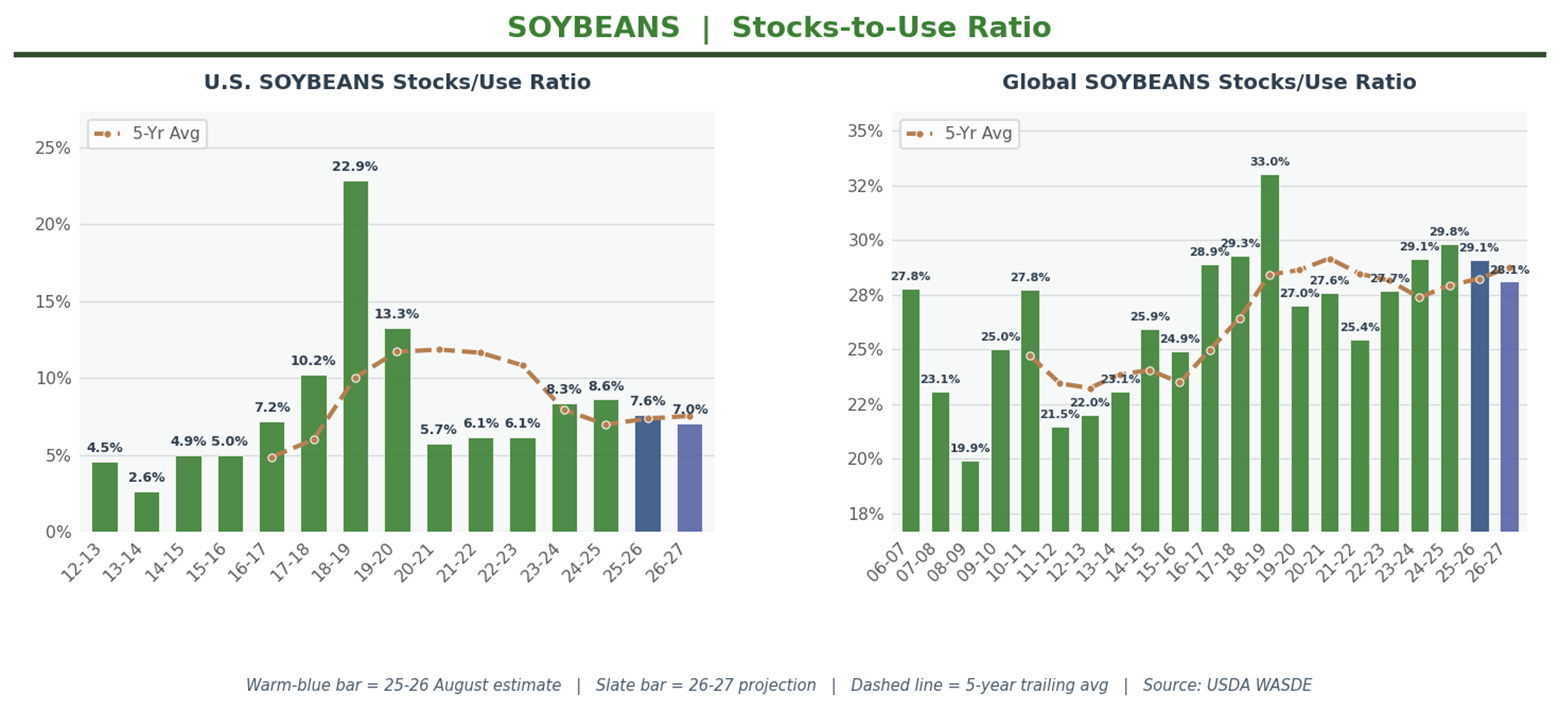
Crush is the story. USDA raised 2026/27 crush 30 million bushels to a record 2,780 million on strong margins and growing meal and oil demand, and soybean meal exports rose 0.7 million short tons to 22.7 million. With exports held at 1,660 million, ending stocks rose 10 million bushels to 320 million, 14 above the 306 million analyst average, which had leaned tighter. Season-average price forecasts were unchanged: $11.40 per bushel for soybeans, $310 per short ton for meal, and 70 cents per pound for oil. New-crop stocks-to-use ticks up to 7.0% from 6.9%, still tight by any historical measure.
Old-crop ending stocks slipped 5 million bushels to 325 million on a slightly higher crush, close to the 323 million analyst average. The 2025/26 season-average price forecast held at $10.40 per bushel. Old-crop stocks-to-use sits at 7.6%, below the 10% line that historically starts to support prices.
Globally, 2026/27 ending stocks were essentially unchanged at 124.21 million metric tons. World new-crop stocks-to-use holds at 28.1%, down about a point from the old crop’s 29.1%.
WHEAT
Wheat production fell 5 million bushels to 1,531 million on slightly lower harvested area and yield, with Hard Red Winter and Durum taking most of the cut, and this would still be the smallest U.S. wheat crop since 1970/71. Ending stocks fell 5 million to 717 million, right on the 718 million analyst average and down 22% from last year.
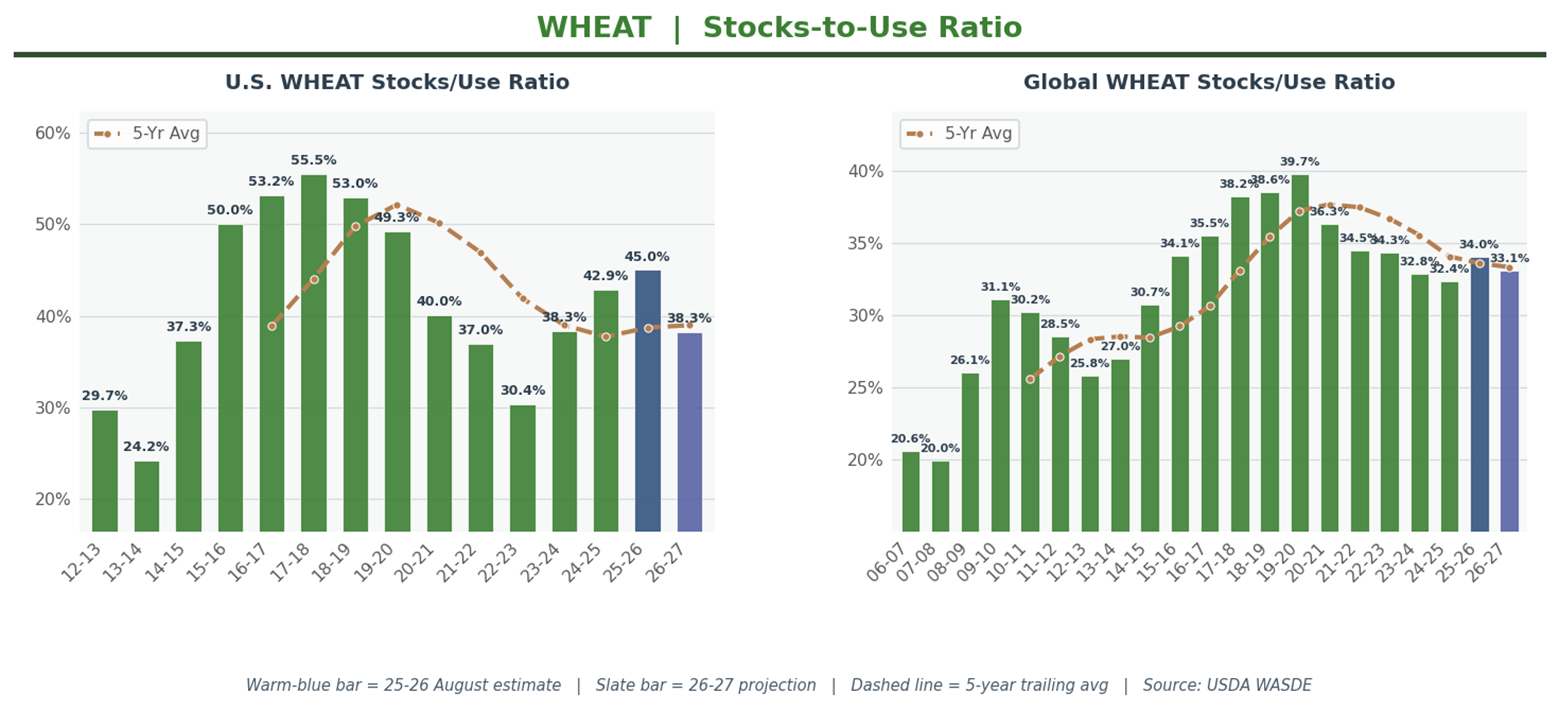
The price forecast moved more than the balance sheet. USDA raised the 2026/27 season-average farm price $0.20 to $6.20 per bushel, citing the lower stocks-to-use ratio and futures and cash prices to date, against a final $5.06 for 2025/26. New-crop stocks-to-use slips to 38.3% from 38.5% in July, a long way down from the just-ended year’s 45.0%.
The global wheat story this month is the Black Sea. USDA cut Russian and Ukrainian exports on logistical disruptions from the widening conflict in the Sea of Azov and Black Sea, dropping world trade 0.3 mmt to 212.7 million. EU and United Kingdom production fell on prolonged summer heat during grain fill, and more EU wheat is moving into feed rations as corn supplies tighten. Even so, world ending stocks rose 0.4 mmt to 273.25 million metric tons, with the increases sitting in Russia and Ukraine, exactly where they’re currently hardest to ship. World stocks-to-use holds near 33.1%.
Four reports into the 2026/27 cycle, the pattern hasn’t broken: demand keeps outrunning supply. The first survey yields trimmed the corn crop, acres put it back, and carryout still fell because exports and crush keep climbing. In our view that’s how Stage #1 typically ends, though the exit is rarely visible until after the fact. September brings FSA acreage data and the next objective-yield update.
The crop is big; the cushion is shrinking.