

China’s Soybean Import Surge: What Export Data Really Shows
China’s soybean imports reached a historic high in 2025, reaffirming the country’s central role in the global oilseed market.¹ At face value, the surge suggests strengthening demand and supportive fundamentals for exporters. A closer look at the trade flows, however, reveals a more nuanced picture. Nearly all of the growth in Chinese imports last year came from South America rather than the United States.²
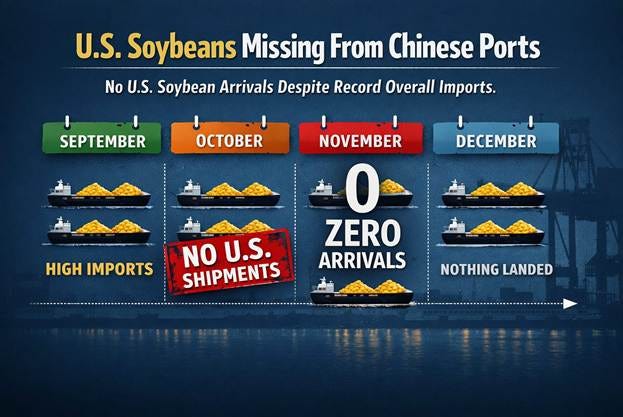
Trade tensions and retaliatory tariffs kept U.S. soybeans largely sidelined for much of the year. Brazilian and Argentine suppliers filled the gap, with Argentina posting an especially sharp rise in shipments as Chinese buyers actively diversified sourcing.² By late autumn, customs data showed consecutive months with no U.S. soybean arrivals at Chinese ports, even as overall imports continued climbing.² The headline number masked a significant geographic shift in supply, one that left U.S. farmers watching from the sidelines during a period of record Chinese buying.
A Late-Year Reentry for U.S. Soybeans
The landscape shifted in late October following a partial easing of trade tensions. Chinese state buyers quickly returned to the U.S. market, booking a large volume of American soybeans in a short period of time.³ These purchases provided a welcome signal that trade channels were reopening, yet timing mattered. Many shipments were scheduled for delivery months later, overlapping with South America’s peak export season.³
As a result, U.S. export totals for the year remained subdued relative to historical norms, even with the late rebound.⁴ The agreement effectively stabilized future trade expectations rather than resetting demand to earlier highs. For market participants, the distinction is important. Sales announcements boosted sentiment, but the delayed shipment profile meant limited near-term impact on cash markets or export statistics.
Why Export Data Lagged the Headlines
The gap between reported sales and actual shipments explains why export data initially appeared underwhelming. China deliberately staggered deliveries, drawing down existing inventories while spacing out incoming cargoes.⁵ This approach helped prevent congestion at ports and avoided oversupplying domestic crushers. Strategic reserve sales further smoothed the transition, allowing China to absorb new imports without disruption.⁶
Globally, the surge in Chinese demand coincided with expanding production capacity. Brazil, already the world’s largest soybean exporter, continued to scale output and shipments, while Argentina also increased exports under more favorable policy conditions.⁴ Looking ahead, early forecasts point to another large South American harvest, reinforcing the view that global supply is growing alongside demand.⁷
For investors, the takeaway is measured optimism. China’s return to the U.S. market removes a meaningful headwind and confirms that underlying demand remains strong. At the same time, ample global supply and disciplined buying strategies suggest that gains are likely to be incremental rather than explosive. The soybean market appears to be entering a phase defined less by shortages and more by competition, timing, and global balance.
Footnotes
Ella Cao and Lewis Jackson, “China’s 2025 Soybean Imports Hit Record, Fuelled by South American Purchases,” Reuters, January 14, 2026.
Ella Cao and Lewis Jackson, “China Imports No U.S. Soybeans for Third Month; Argentine Arrivals Surge,” Reuters, December 20, 2025.
Naveen Thukral and Ella Cao, “China Buys More U.S. Soybeans as Purchases Approach Annual Targets,” Reuters, January 6, 2026.
Joana Colussi and Michael Langemeier, “U.S.–China Soybean Deal and Global Market Impacts,” farmdoc daily, University of Illinois at Urbana-Champaign, November 17, 2025.
Arlan Suderman, “Why China’s Soybean Buying Has Yet to Lift U.S. Exports,” StoneX Market Intelligence, December 17, 2025.
Ella Cao and Lewis Jackson, “Sinograin Auctions Soybeans Ahead of U.S. Shipments,” Reuters, January 12, 2026.
Ana Mano, “Brazil Soybean Output Seen at Record Levels,” Reuters, January 15, 2026.
The information provided on this page and its associated documents is intended to provide a broad overview for discussion purposes. It is subject to change and should not be taken as financial or investment advice. Teucrium Trading LLC and Teucrium Investment Advisors, LLC make no offers to sell, solicitations to buy, or recommendations for any security.
ame from South America rather than the United States.²
Trade tensions and retaliatory tariffs kept U.S. soybeans largely sidelined for much of the year. Brazilian and Argentine suppliers filled the gap, with Argentina posting an especially sharp rise in shipments as Chinese buyers actively diversified sourcing.² By late autumn, customs data showed consecutive months with no U.S. soybean arrivals at Chinese ports, even as overall imports continued climbing.² The headline number masked a significant geographic shift in supply, one that left U.S. farmers watching from the sidelines during a period of record Chinese buying.
A Late-Year Reentry for U.S. Soybeans
The landscape shifted in late October following a partial easing of trade tensions. Chinese state buyers quickly returned to the U.S. market, booking a large volume of American soybeans in a short period of time.³ These purchases provided a welcome signal that trade channels were reopening, yet timing mattered. Many shipments were scheduled for delivery months later, overlapping with South America’s peak export season.³
As a result, U.S. export totals for the year remained subdued relative to historical norms, even with the late rebound.⁴ The agreement effectively stabilized future trade expectations rather than resetting demand to earlier highs. For market participants, the distinction is important. Sales announcements boosted sentiment, but the delayed shipment profile meant limited near-term impact on cash markets or export statistics.
Why Export Data Lagged the Headlines
The gap between reported sales and actual shipments explains why export data initially appeared underwhelming. China deliberately staggered deliveries, drawing down existing inventories while spacing out incoming cargoes.⁵ This approach helped prevent congestion at ports and avoided oversupplying domestic crushers. Strategic reserve sales further smoothed the transition, allowing China to absorb new imports without disruption.⁶
Globally, the surge in Chinese demand coincided with expanding production capacity. Brazil, already the world’s largest soybean exporter, continued to scale output and shipments, while Argentina also increased exports under more favorable policy conditions.⁴ Looking ahead, early forecasts point to another large South American harvest, reinforcing the view that global supply is growing alongside demand.⁷
For investors, the takeaway is measured optimism. China’s return to the U.S. market removes a meaningful headwind and confirms that underlying demand remains strong. At the same time, ample global supply and disciplined buying strategies suggest that gains are likely to be incremental rather than explosive. The soybean market appears to be entering a phase defined less by shortages and more by competition, timing, and global balance.
Footnotes
Ella Cao and Lewis Jackson, “China’s 2025 Soybean Imports Hit Record, Fuelled by South American Purchases,” Reuters, January 14, 2026.
Ella Cao and Lewis Jackson, “China Imports No U.S. Soybeans for Third Month; Argentine Arrivals Surge,” Reuters, December 20, 2025.
Naveen Thukral and Ella Cao, “China Buys More U.S. Soybeans as Purchases Approach Annual Targets,” Reuters, January 6, 2026.
Joana Colussi and Michael Langemeier, “U.S.–China Soybean Deal and Global Market Impacts,” farmdoc daily, University of Illinois at Urbana-Champaign, November 17, 2025.
Arlan Suderman, “Why China’s Soybean Buying Has Yet to Lift U.S. Exports,” StoneX Market Intelligence, December 17, 2025.
Ella Cao and Lewis Jackson, “Sinograin Auctions Soybeans Ahead of U.S. Shipments,” Reuters, January 12, 2026.
Ana Mano, “Brazil Soybean Output Seen at Record Levels,” Reuters, January 15, 2026.
The information provided on this page and its associated documents is intended to provide a broad overview for discussion purposes. It is subject to change and should not be taken as financial or investment advice. Teucrium Trading LLC and Teucrium Investment Advisors, LLC make no offers to sell, solicitations to buy, or recommendations for any security.