

Global Wheat Demand Trends: Export Data Insights Amid U.S. Market Pressures
After several difficult seasons, the global wheat market is showing early signs of adjustment. Years of ample harvests outside the United States, combined with drought-related challenges at home, pushed U.S. wheat exports toward multidecade lows. Recently, however, shifting prices and renewed import demand suggest that the balance between supply and demand may be evolving.
A Recent History of Oversupply
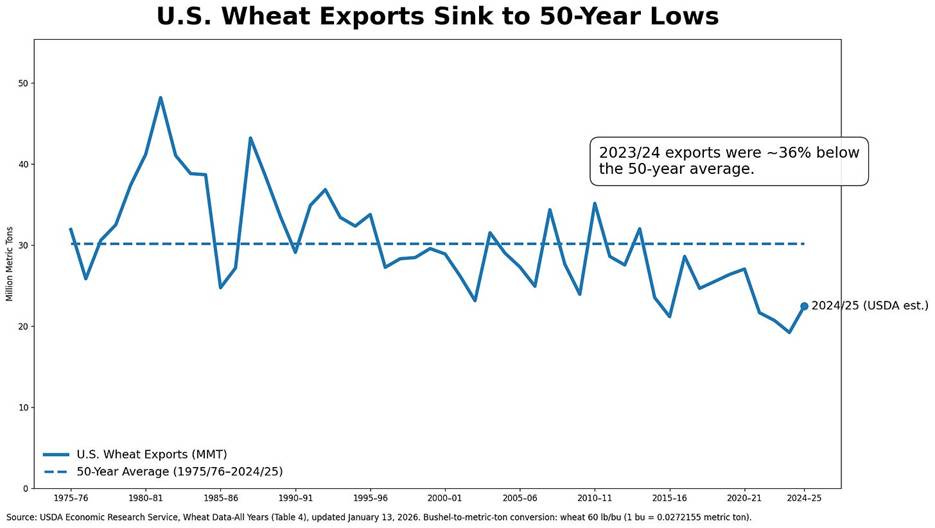
In 2023, U.S. wheat exports were projected to fall to their lowest level in more than five decades, as domestic production struggled and global competitors filled the gap.¹ Record or near-record harvests in Russia, France, and Ukraine flooded export markets with lower-priced wheat, leaving U.S. exporters at a disadvantage.² With global production running strong, wheat prices declined to multi-year lows.³
The pressure filtered quickly back to farmers. Hard Red Winter wheat acreage, the backbone of U.S. wheat production, dropped to the smallest level recorded since the 1970s.⁴ For many producers, thin margins made wheat less attractive than alternative crops. By the end of 2024, the prevailing narrative was clear: the world had plenty of wheat, and U.S. exporters were struggling to find buyers.
Low Prices Rekindle Global Demand
As prices softened through late 2025, global buyers began to respond. Importers who had delayed purchases stepped back into the market once values reached levels difficult to ignore. Algeria provided one of the most visible examples, purchasing roughly 600,000 metric tons of wheat in a single tender, exceeding initial expectations.⁵ The transaction underscored a familiar dynamic in commodity markets: sufficiently low prices tend to stimulate demand.
Other importers followed. Countries across North Africa, the Middle East, and parts of Asia increased bookings as wheat became more affordable. By early 2026, global consumption was projected to reach a record high, supported by rising food and feed demand in populous nations.⁶ This includes China, which is expected to increase wheat imports significantly not only for feed but also due to weather related production concerns.⁷ The market has thus begun absorbing some of the world’s excess supply.
U.S. Wheat Searches for a Foothold
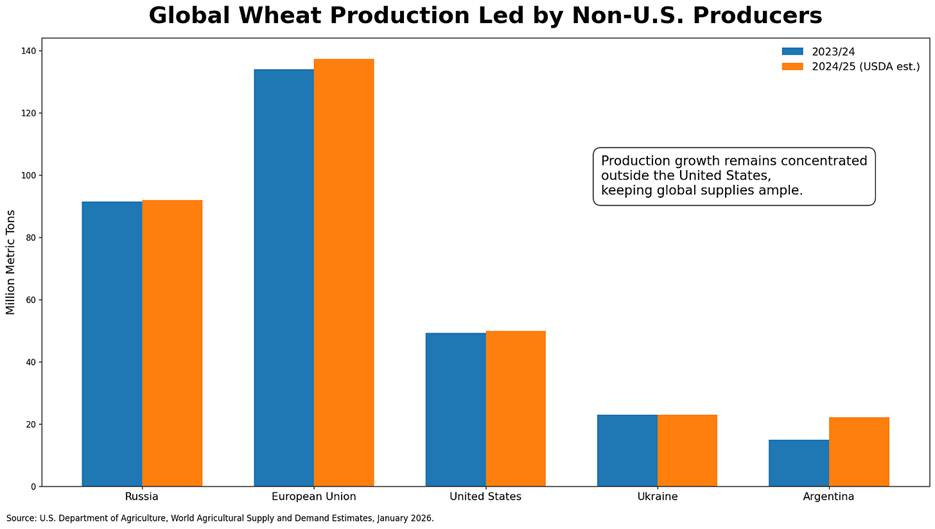
Despite improving demand conditions, U.S. wheat continues to face stiff competition. Russia remains the world’s dominant exporter, while Argentina’s record harvest has added further price pressure.⁸ For many, U.S. wheat has remained a secondary option.
Still, there are signs of renewed activity. Weekly U.S. export sales reported in mid-January showed the strongest volume in more than two months, more than triple the level recorded during the same period a year earlier.⁹ Shipments for the current marketing year are running well ahead of last year’s pace, reflecting increased price competitiveness.¹⁰ Forward sales have also improved, reaching their highest levels in over a decade before the current season began.¹¹
From an investment perspective, the market appears to be in transition rather than in recovery. Global inventories remain ample, and prices remain sensitive to competition and weather outcomes. At the same time, reduced acreage in the United States and potential restrained production in other exporting regions could tighten supplies over time if demand continues to firm. The wheat market, long cyclical in nature, appears to be edging toward balance.
Footnotes
Sarah Zimmerman, “U.S. Wheat Exports Expected to Hit 52-Year Low,” Agriculture Dive, August 23, 2023.
U.S. Department of Agriculture, Economic Research Service, “Global Wheat Production and Trade Outlook,” February 2024.
U.S. Department of Agriculture, World Agricultural Supply and Demand Estimates, December 8, 2024.
U.S. Department of Agriculture, National Agricultural Statistics Service, “Winter Wheat Plantings Summary,” January 12, 2024.
Reuters, “Algerian Wheat Buyers Signal Large Import Tender,” October 23, 2025.
U.S. Department of Agriculture, World Agricultural Outlook Board, “World Wheat Consumption Forecast,” January 12, 2026.
CME Group OpenMarkets, “How Weather Is Reshaping Wheat Production,” November 14, 2025.
Reuters, “Argentina Harvests Record Wheat Crop,” December 18, 2025.
U.S. Department of Agriculture, Foreign Agricultural Service, “Weekly Export Sales Report,” January 16, 2026.
Agriculture.com, “U.S. Wheat Shipments Accelerate Early in 2026,” January 27, 2026.
Reuters, “U.S. Wheat Export Commitments Reach Multi-Year Highs,” June 9, 2025.
The information provided on this page and its associated documents is intended to provide a broad overview for discussion purposes. It is subject to change and should not be taken as financial or investment advice. Teucrium Trading LLC and Teucrium Investment Advisors, LLC make no offers to sell, solicitations to buy, or recommendations for any security.