

How Reduced Wheat Acres Could Shape 2026 Price Action
Small shifts in planting decisions often have outsized consequences in agricultural markets, and wheat appears to be approaching one of those inflection points. Across the U.S. Plains, farmers have quietly reduced wheat acreage, a move that may have meaningful implications for supply and price dynamics in 2026.
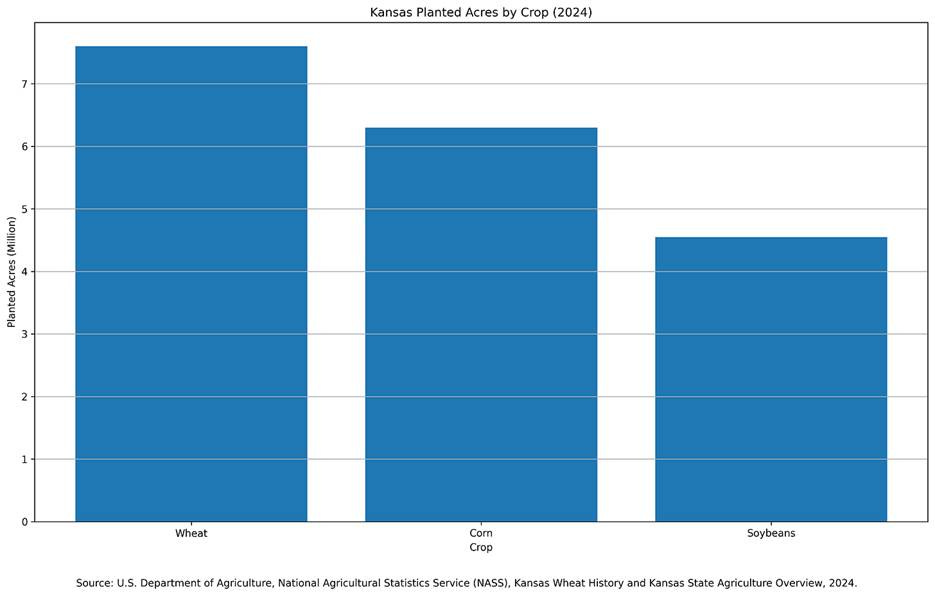
In Kansas, the nation’s largest wheat-producing state, planted acreage is expected to decline from last year’s levels. A delayed corn and soybean harvest pushed winter wheat seeding later than usual, while prices offered little incentive to expand acreage. Weather added another hurdle, as dry conditions prevented some fields from being planted altogether.¹ Similar trends have emerged farther north, where growers have increasingly shifted acreage toward corn and soybeans, crops that currently offer stronger revenue potential per acre.²
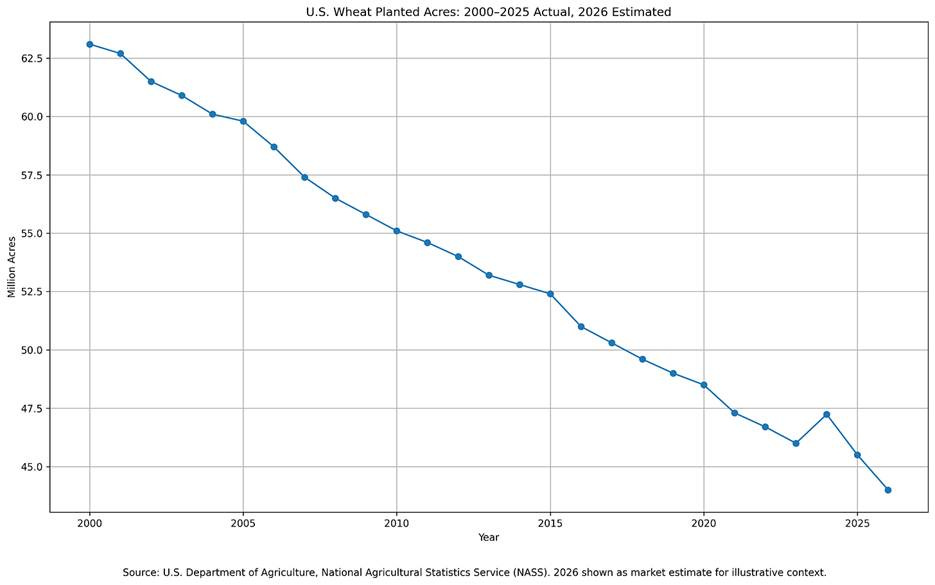
While not every wheat-producing state is cutting back, the broader national picture points to stagnation near historically low levels. U.S. wheat acreage has hovered near multidecade lows, and early indicators suggest a further modest decline ahead of the 2026 harvest.³ The underlying driver is economics. Global oversupply weighed on wheat prices through much of 2025, compressing margins just as production costs continued to climb.⁴ For many producers, the goal has shifted from maximizing returns to minimizing losses, leading some to scale wheat plantings back to their most productive ground.⁴
Acreage Declines and the Supply Outlook
Acreage reductions matter because they cap potential production. Although U.S. wheat yields reached record levels in 2025, that outcome relied heavily on favorable weather.³ Betting on consecutive years of ideal conditions carries risk. Forecasts pointing to a transition toward La Niña increase the likelihood of warmer, drier weather across parts of the Southern Plains, a pattern that can hinder winter wheat development.³ With fewer acres already planted, even modest yield shortfalls could translate quickly into a smaller U.S. crop in 2026.
Demand conditions remain comparatively stable. Domestic wheat consumption for food has shown little long-term variability, while global use continues to trend higher alongside population growth and dietary changes.³⁵ Recent years of ample global production helped satisfy that demand, but stockpiles are no longer as comfortable as they once were. Russia, the world’s largest wheat exporter, is expected to carry lower reserves, and other major exporters lack large surplus buffers.⁶ This reduces the system’s ability to absorb shocks. In that context, fewer U.S. acres limit the country’s capacity to offset production shortfalls elsewhere, increasing the market’s sensitivity to disruptions.
What It Means for the 2026 Market
Looking toward 2026, the wheat market appears more balanced than it did a year ago. Many analysts anticipate a smaller U.S. harvest, which would provide a firmer foundation for prices if demand remains steady.³ Still, tighter conditions do not guarantee sustained strength. Wheat remains a global commodity, and another year of strong harvests abroad could keep supplies ample. Competition from lower-cost exporters and currency dynamics may also temper U.S. export prospects.
The key takeaway is not that reduced acreage ensures higher prices, but that it narrows the margin for error. With fewer acres in the ground, weather events, geopolitical disruptions, or shifts in trade flows carry greater weight. For investors and observers alike, the acreage pullback signals a market that may respond more quickly to surprises. In commodity markets, those quiet decisions made months before harvest often matter most.
Footnotes
Brownfield Ag News, “Kansas Wheat CEO Expects Fewer Acres Despite Strong Crop Conditions,” September 19, 2025.
Agweek, “What’s to Come in Wheat in 2026 After a 2025 of Decreased Acres and Increased Yields,” October 3, 2025.
Southern Ag Today, “2026 Wheat Outlook,” December 17, 2025.
AgWest Farm Credit, “Wheat: Industry and Economic Insights,” December 2025.
U.S. Department of Agriculture, Economic Research Service, “Wheat Data and Statistics,” November 15, 2025.
Terrain Ag, “Fewer Winter Wheat Acres?” November 2025.
The information provided on this page and its associated documents is intended to provide a broad overview for discussion purposes. It is subject to change and should not be taken as financial or investment advice. Teucrium Trading LLC and Teucrium Investment Advisors, LLC make no offers to sell, solicitations to buy, or recommendations for any security.