

July WASDE Analysis


USDA delivered real news in July, and most of it leaned friendly. The June 30 Grain Stocks and Acreage reports worked their way into the balance sheets this month, and corn came out the other side much tighter: old-crop carryout cut 125 million bushels on booming feed demand, new-crop carryout down 170 million to 1,790 million, essentially matching the lowest estimate in the Bloomberg analyst survey. Wheat added a headline of its own, with production forecast at the smallest U.S. wheat crop since 1970/71.
We remain in Golden Grain Cycle Stage #1, with prices near cost of production, but demand appears to be doing what eventually ends Stage #1: quietly eating through the cushion.
CORN
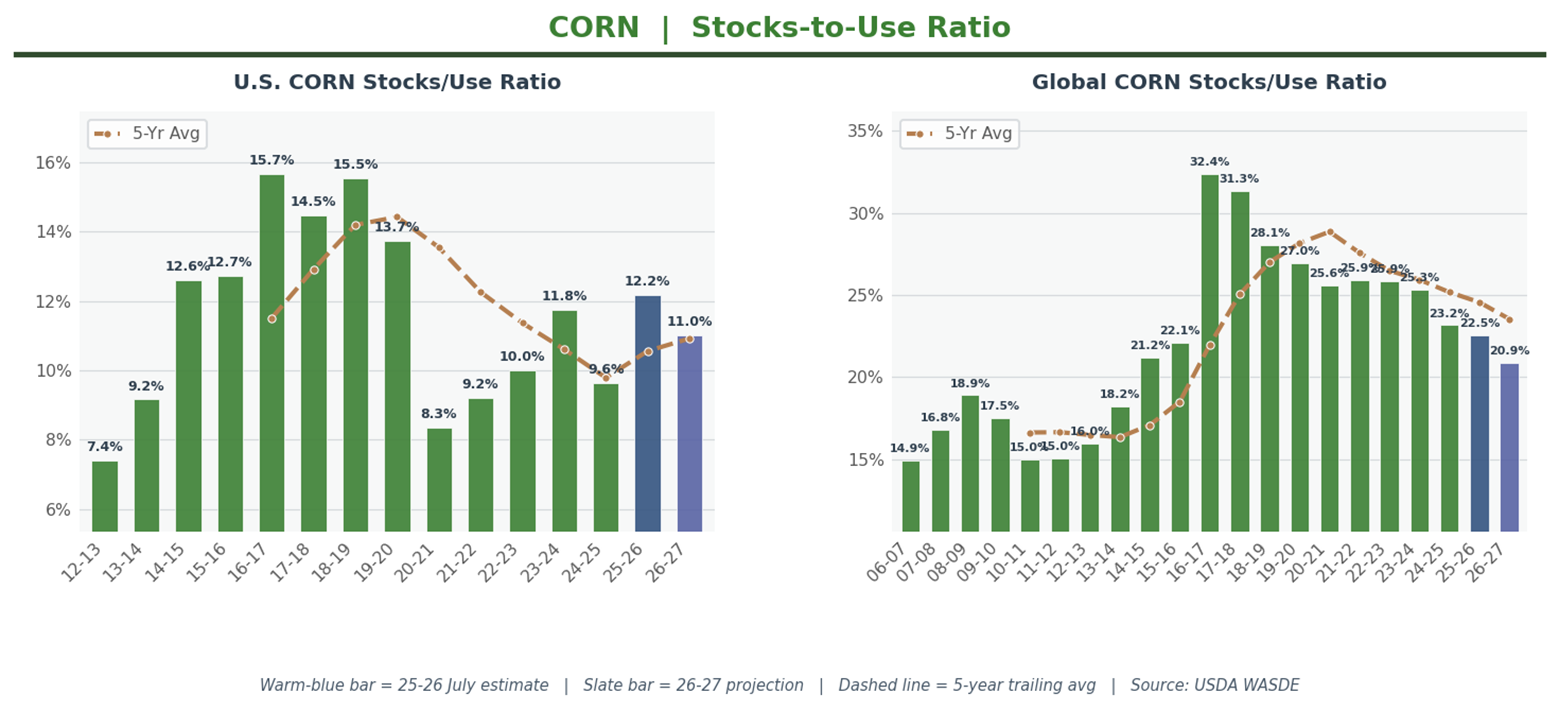
The old-crop story is feed demand. The June 30 Grain Stocks report showed just over 5.6 billion bushels of feed and residual disappearance through the first three quarters of the marketing year, versus roughly 4.8 billion a year earlier. USDA responded by raising 2025/26 feed and residual use 150 million bushels to 6,350 million, partly offset by a 25 million bushel cut to corn used for ethanol. Old-crop ending stocks fell 125 million to 2,020 million bushels, 59 below the 2,079 million analyst average. The 2025/26 season-average price forecast held at $4.15 per bushel. Old-crop stocks-to-use now sits at 12.2%, down from 13.0% in June.
New crop tightened even more. Production edged up 5 million bushels to 16,000 million on updated area from the Acreage report (95.3 million acres planted, 87.4 million harvested), with the yield held at 183.0 bushels per acre. Exports were raised 50 million to 3,200 million on expectations of continued global demand strength, and the smaller carry-in did the rest. Ending stocks fell 170 million bushels to 1,790 million. That’s 109 below the 1,899 million analyst average and 1 million bushels above the lowest estimate in the survey. The 2026/27 season-average price forecast held at $4.40 per bushel. New-crop stocks-to-use drops to 11.0% from 12.1% in June.
The global book tightened right alongside. World 2026/27 ending stocks fell 6.0 mmt to 275.26 million metric tons. Record heat cut France’s crop, potentially the smallest French corn harvest in more than three decades, with Hungary and Kenya also reduced and ending stocks trimmed for China, Ukraine, and the EU. Old-crop world stocks came down 4.7 mmt to 298.67 million, with the U.S. feed revision the biggest piece. World new-crop stocks-to-use falls to 20.8% from 21.3% in June and continues to point toward the tightest global corn carryout in over a decade.
SOYBEANS
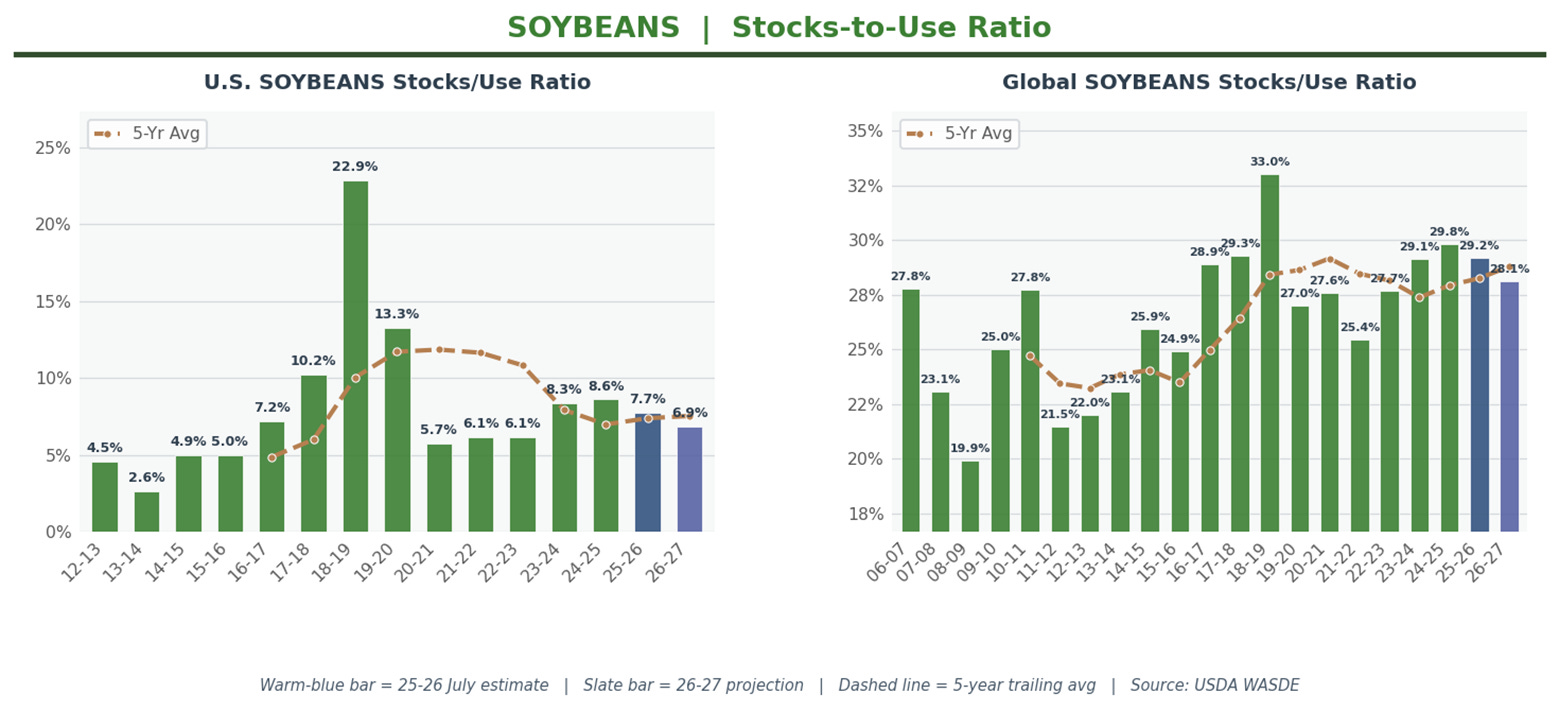
Soybeans got more acres and found a home for them. Production rose 40 million bushels to 4,475 million on harvested area of 84.4 million acres from the Acreage report, up 0.7 million from June, with the yield forecast unchanged at 53.0 bushels per acre. USDA raised exports 30 million bushels to 1,660 million on the bigger supplies and stronger global demand, and with beginning stocks 10 million lower, ending stocks held at 310 million bushels. That’s 22 below the 332 million analyst average, which had leaned toward a bigger build. The 2026/27 season-average price forecasts were unchanged: $11.40 per bushel for soybeans, $310 per short ton for meal, and 70 cents per pound for oil. New-crop stocks-to-use stays at 6.9%, still very tight.
Old-crop ending stocks slipped 10 million bushels to 330 million on a 10 million bushel bump to exports, now 1,520 million. Crush held at 2,650 million. The 2025/26 season-average price forecast stayed at $10.40 per bushel. Old-crop stocks-to-use sits at 7.7%, below the 10% line that historically starts to support prices.
Globally, 2026/27 ending stocks eased 0.7 mmt to 124.17 million metric tons, mainly on lower Brazilian stocks as Brazil’s export forecast rose 0.5 mmt to 118 million. China’s import and crush forecasts were each raised 1.0 mmt, to 115 and 111 million, keeping its projected meal demand growth at 2 percent. World new-crop stocks-to-use eases to 28.1% from 29.2% in the old crop.
WHEAT
At 1,536 million bushels, this would be the smallest U.S. wheat crop since 1970/71. Production fell 7 million from June even as the all-wheat yield rose 0.9 bushels to 47.9 per acre, because the acres aren’t there. Winter wheat production was cut 39 million bushels to 990 million, almost entirely Hard Red and Soft Red, while NASS’s first survey-based spring numbers put other spring wheat at 475 million and Durum at 71 million, both down on smaller harvested area.
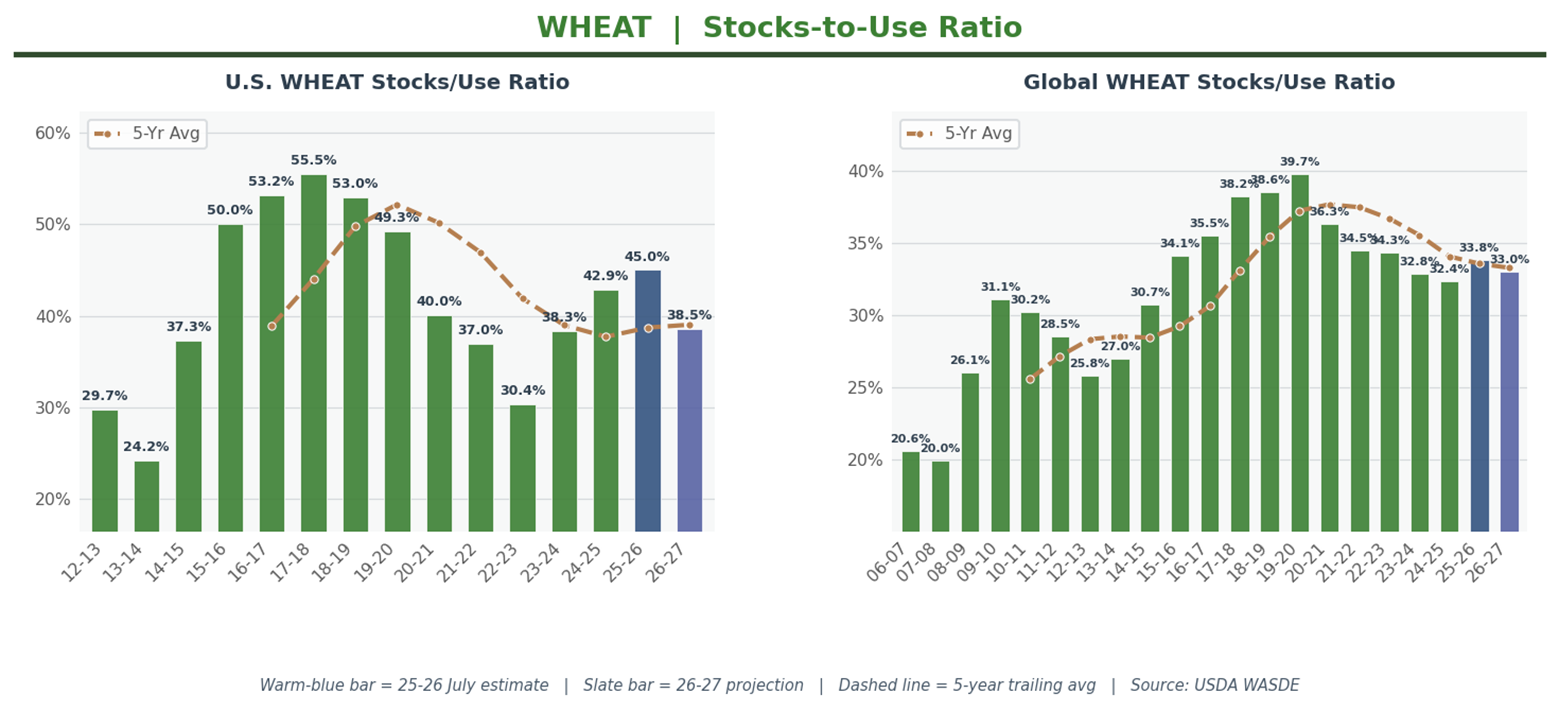
With beginning stocks 15 million lower and no changes to domestic use or exports, 2026/27 ending stocks fell 22 million bushels to 722 million, 4 above the 718 million analyst average and down 22% from last year. USDA’s new-crop carryout forecast has now fallen in back-to-back reports, from 762 million in May to 722 today. The 2026/27 season-average price forecast held at $6.00 per bushel against a final $5.06 for 2025/26. New-crop stocks-to-use steps down to 38.5% from 39.7% in June.
Old-crop bookkeeping closed with 2025/26 ending stocks at 920 million bushels, 15 below June’s figure, on modestly higher final use. Stocks-to-use for the just-ended marketing year lands at 45.0%. That’s the burdensome backdrop the new crop has to work down, and a 22% smaller carryout is a meaningful first step.
Globally, 2026/27 ending stocks fell 2.6 mmt to 272.84 million metric tons, with cuts for the United States, India, Argentina, and Canada. Russia and Ukraine both got production increases, to 88.5 and 24.0 mmt, on favorable winter wheat weather, while Canada lost 1.0 mmt on Statistics Canada’s area report. World consumption rose 1.6 mmt to 826.2 million on food demand led by India, and trade moved up 1.1 mmt to 213.1 million. World stocks-to-use slips to 33.0%, still comfortable by historical standards but tightening at the margin.