

Sugar's Fuel Tank: How E-32 Reshapes the Balance Sheet
A two-point change in Brazilian fuel policy could help flip the balance sheet into a deficit

Sugar #11 has spent most of April and early May in a choppy range, settling higher to close last week as a firmer Brazilian currency lent support.1 The price action looks unremarkable on the surface. Underneath it, the fundamental story has changed.
Brazilian President Lula da Silva confirmed last week that the mandatory ethanol blend in gasoline is moving to 32 percent, up from 30 percent. The market has been calling it E-32. In our view, that two-point change is set to meaningfully reshape the 2026/27 global sugar balance sheet.
The Biofuel Magnet
Brazilian mills are flexible by design. Every ton of cane that comes through the gate can be processed into either sugar or ethanol, and the split is decided week to week based on which product pays better. A higher domestic ethanol mandate raises the floor under ethanol demand, which raises the floor under what mills can charge for it. This supports more cane being processed for fuel.
UNICA’s data already shows the rotation underway. In the first half of April, Center-South sugar production was reported down meaningfully versus the prior year, and the sugar-to-ethanol allocation moved closer to a 33-67 split in ethanol’s favor. That was before the E-32 announcement was confirmed. The policy change reinforces what the price signal the market was already sending to mills.
From Surplus to Squeeze
The 2026/27 global sugar surplus, the cushion that analysts have been counting on to keep prices anchored, looks materially smaller than it did three months ago. Some forecasters have already flipped their estimate from a modest surplus to a deficit, with figures in the range of negative 4 million tons making the rounds.2 Those numbers are still moving, but the direction is clear.
Putting policy aside, market participants are keeping a close eye on weather. Of particular interest is India’s monsoon outlook, where concerns regarding potential below normal rainfall could impact production and limit exports.
Elsewhere in Asia, Thailand is producing more, but not enough to offset a Brazilian rotation of this size.
The marginal ton of global sugar supply, in our view, has to come from Brazilian mills. Currently those mills are far more likely to choose to produce ethanol instead.
The Price Implication
Sugar’s choppy range over the last few weeks is understandable given the volatility in outside markets, most notably oil.
Still, while prices may continue to chop, the market does not have clarity around Brazilian ethanol policy. As long as Brazilian fuel demand is supported by mandate and gasoline prices stay firm, the opportunity cost of making sugar instead of ethanol stays elevated. That sets a price below which it is no longer worth diverting cane back toward the sweetener.
What to Watch
The next UNICA bi-monthly release on Center-South production and the sugar-ethanol mix is the cleanest read on whether mills are actually rotating in line with the policy signal.
Beyond UNICA, India’s monsoon onset is in early June. A forecast for adequate rain could potentially support ideas of a surplus crop once again. A dry forecast would add to concerns of a tightening balance sheet.
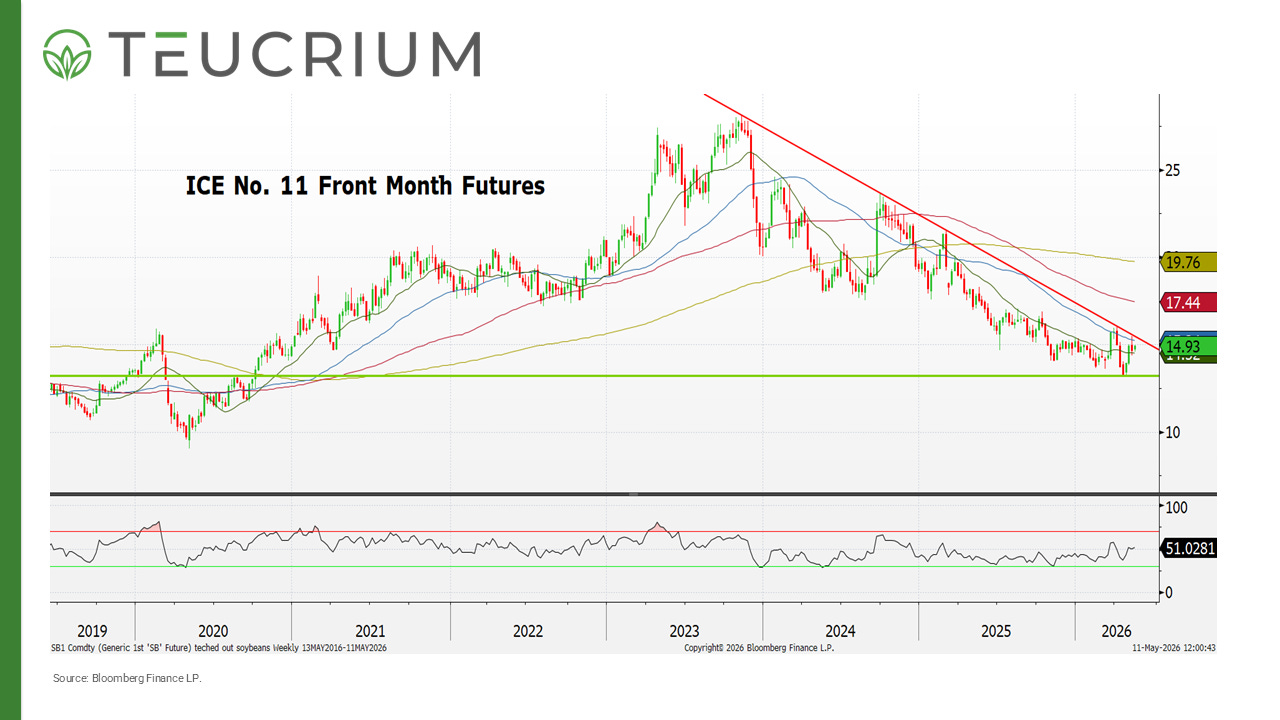
It’s worth noting that prices reached 5-year lows in April, matching prices not seen since 2020. While prices have been volatile recently, zooming out we see a downtrend that has been in place since 2023.
While prices have been choppy, the policy / weather combination discussed above has the potential to help set a new trend. A break back below April’s low ~ 13.00 could lead to an accelerated downtrend, where a move back above April’s high, and ultimately up through 16.00 would support ideas of a new trend higher.
Time will tell.
“Sugar Prices Settle Higher on Brazilian Real Strength," Barchart, May 8, 2026, https://www.tradingview.com/news/barchart:86a97cf31094b:0-sugar-prices-settle-higher-on-brazilian-real-strength/.
"Sugar - Price - Chart - Historical Data - News," Trading Economics, May 6, 2026, https://tradingeconomics.com/commodity/sugar.