

Wheat's Risk Premium Returns Through the Kerch Strait

Frankly, we got it wrong in 2022. We expected Russia to establish and enforce a total blockade of Ukraine’s Black Sea ports. The logic seemed sound at the time: nations fight wars to win, a prolonged blockade would inflict maximum economic pain, and Russia had already committed the blood and treasure of an invasion. Russia walked a more calculated line instead.
The blockade came, but it leaked. Through negotiations brokered by the United Nations and Türkiye, Russia agreed to let Ukrainian grain ships transit the Black Sea under the Black Sea Grain Initiative, signed in Istanbul on July 22, 2022.1 The war premium that had flooded into wheat bled out with each successful shipment. Front-month Chicago wheat peaked at $14.25 1/4 per bushel on March 7, 2022; it finished that December below $8.2
Ukraine’s Rerouting Machine
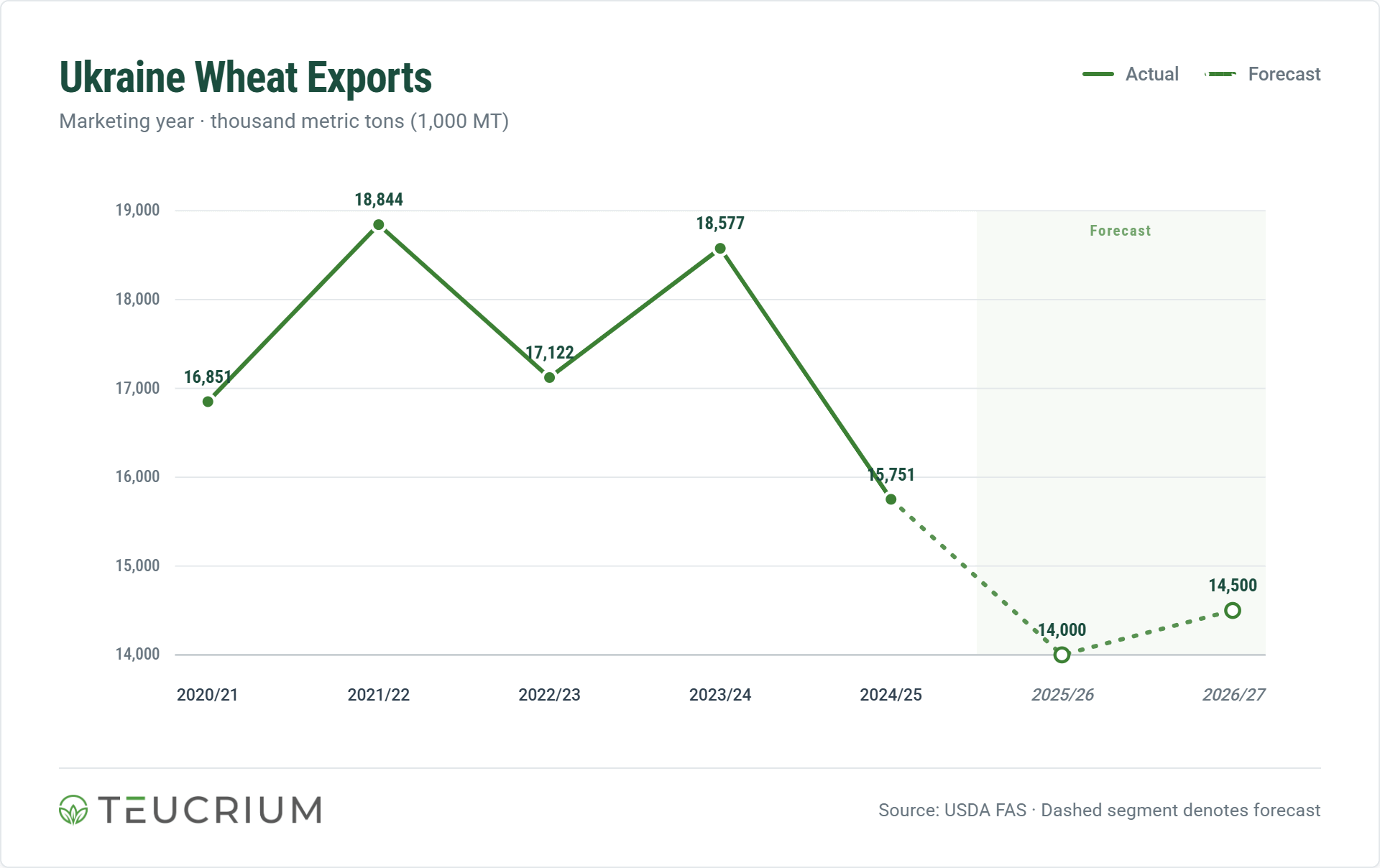
The Ukrainian farm economy proved remarkably resilient. Grain moved west by rail and road and down the Danube through the EU’s Solidarity Lanes, which carried roughly 60% of Ukraine’s grain exports while the Initiative ran.3 When Russia terminated its participation in July 2023,4 Ukraine stood up its own shipping corridor hugging the western Black Sea coast. It worked: by this spring, roughly 90% of Ukraine’s grain and oilseed exports moved by sea again.5 Wheat exports never collapsed the way the early headlines implied: 18.8 million metric tons in 2021/22, 17.1 million in the first full war year, and between 14 and 18.6 million every season since.6
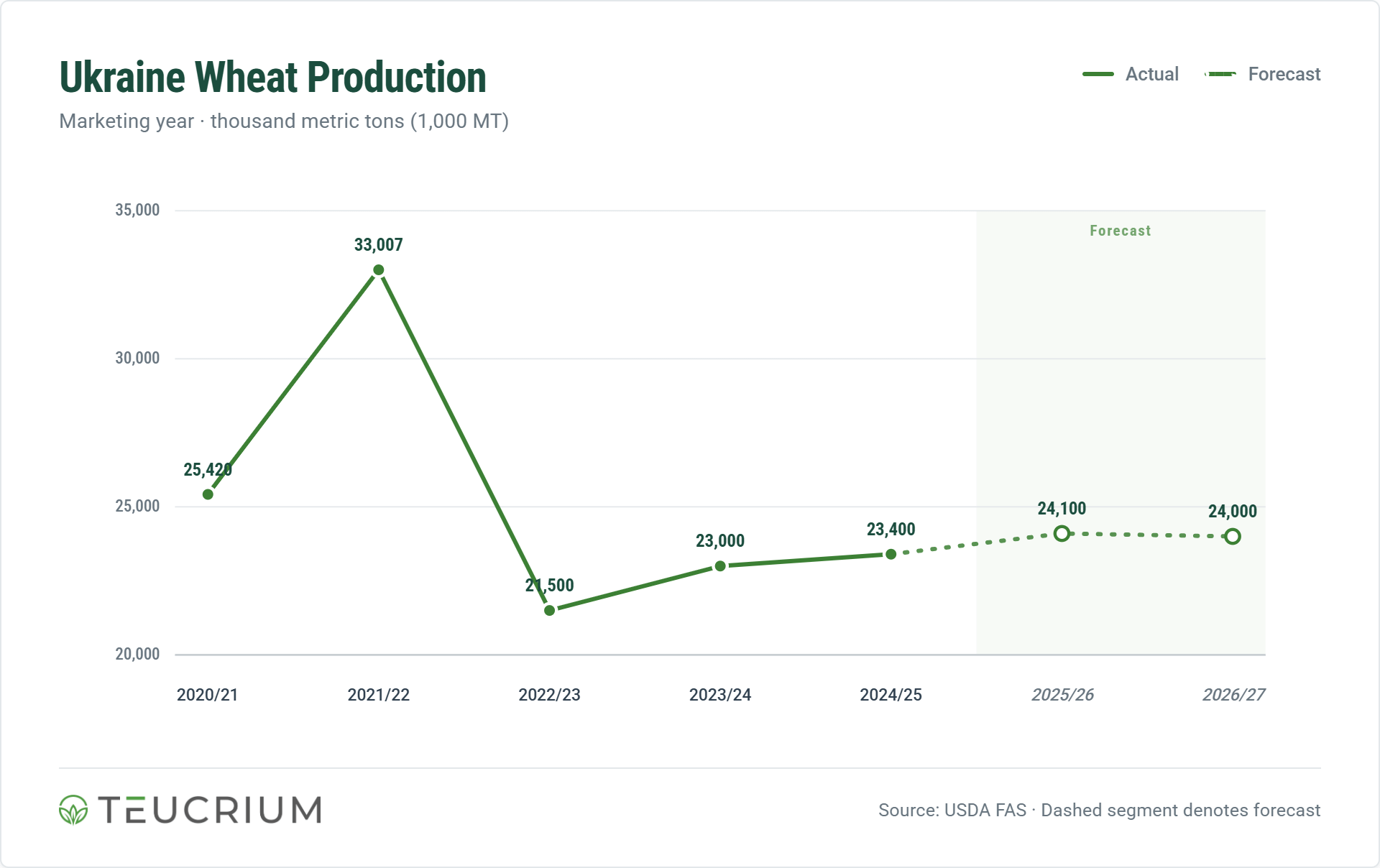
The softer export pace of the last two seasons started in the field. Ukraine harvested a record 33 million tons of wheat in 2021/22, planted before the invasion. The next crop came in at 21.5 million, and production has stabilized in the 23 to 24 million ton range since.7 The front line runs through the chernozem belt, some of the most fertile soil on earth, and the occupied portions of Donetsk, Luhansk, Kherson, and Zaporizhzhia grew about 21% of Ukraine’s pre-war wheat.8 Many of the farmers who worked that ground have now spent four growing seasons fighting instead of planting.
A Comfortable Market, Until Friday
Through the week ending July 10, the global balance sheet looked comfortable. USDA’s July WASDE put world ending stocks at 279 million tons for 2025/26, the highest in several years on record world production, with 272.8 million projected for 2026/27.9 Front-month Chicago wheat closed July 9 at $6.11 1/4, in the bottom quarter of its five-year range.10
Then Ukraine set the Sea of Azov on fire.
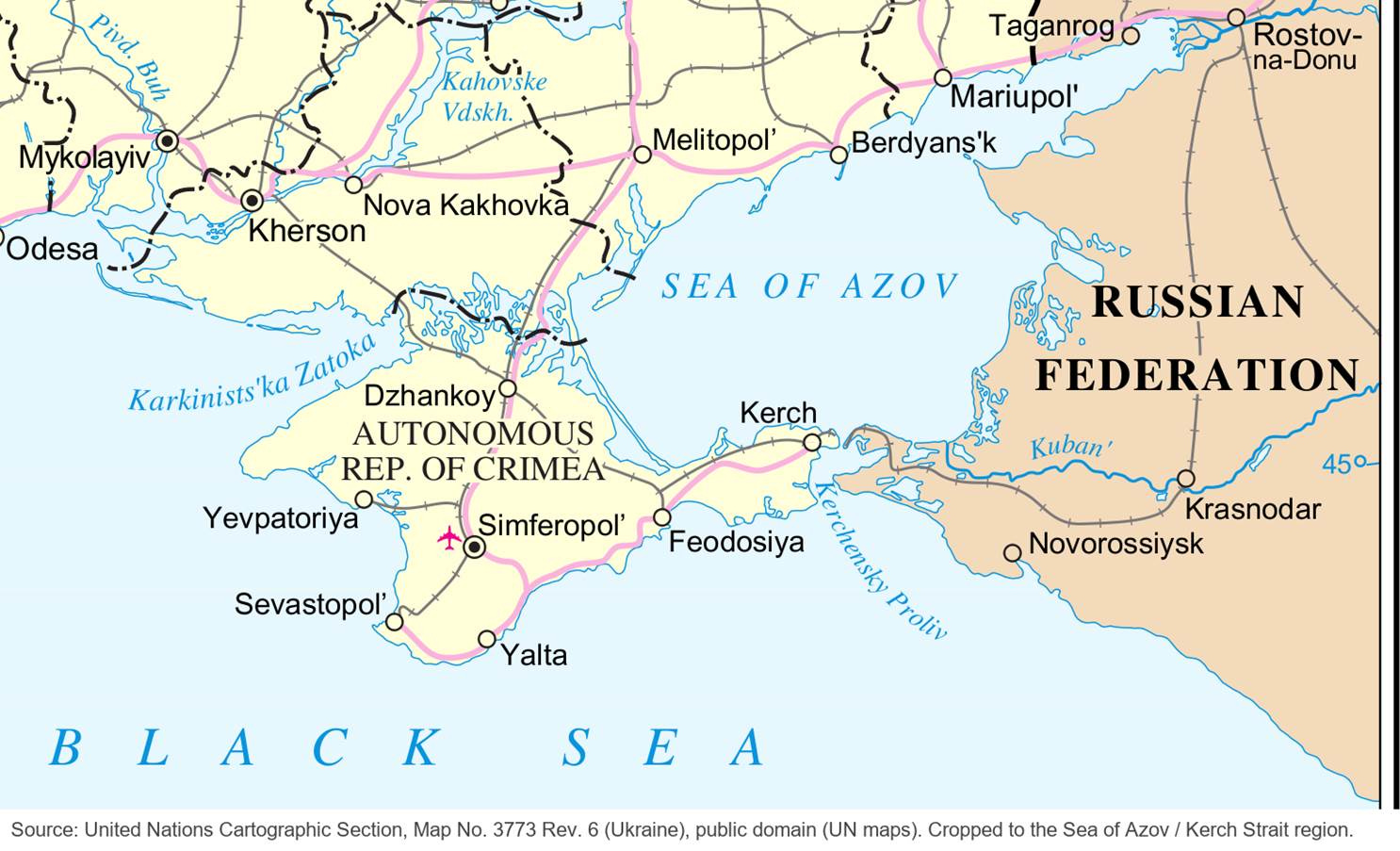
Beginning in early July, Ukrainian naval drones ran one of the largest anti-shipping campaigns of the war: more than 100 vessels hit over eight days by one count, including 21 tankers claimed in a single night.11 The targets were Russia’s shadow-fleet tankers, the ships that move sanctioned oil and carry fuel toward Crimea.12 Grain carriers share the same water and the same ports. On the evening of July 10, Russia’s border guards stopped accepting applications for passage through the Kerch Strait, with no end date given, and traffic on the Don-Azov canal was suspended the same day.13 Russia closed its own export artery to protect it.
Russia is the world’s largest wheat exporter, shipping 48 million tons in 2025/26, roughly 21% of world trade.14 Up to a quarter of its wheat moves through the Azov system: down the river network to shallow-water elevators at Rostov-on-Don, Azov, and Taganrog, out through the Kerch Strait, and onto deep-sea vessels bound for buyers as close as Turkey and as far as Bangladesh, with Egypt, Iran, Lebanon, and Israel in between.15 SovEcon’s math frames the risk. Russia’s deep-sea Black Sea ports can handle roughly 4 million tons a month and cannot absorb the Azov volumes during the August-to-November export peak; a halt that runs toward year-end could cut Russian wheat exports by 5 to 10 million tons.16
The Trade That Worked for Two and a Half Years
The tape’s first reaction followed the old script. Chicago wheat jumped 3.4% on Friday, July 10 as the strikes hit the wires, then went flat Monday and Tuesday while traders leaned into the fade; Reuters quoted one German trader suggesting the disruption might “not be as bad as initially feared.”17 By midday Wednesday the market had thought better of it, with the front month trading at $6.65 1/2, up 5.3% from Friday’s close.18
Andrey Sizov, managing director of the Black Sea grain consultancy SovEcon, told Standard Grain’s Joe Vaclavik on July 14 that the market looks “too relaxed.” Traders have spent two and a half years profitably selling every Black Sea spike, and Sizov isn’t convinced the playbook holds: “We’re not sure that it’s gonna be the case this time.”19
Escalation, in Both Directions
Russia answered in kind. Its drones and missiles hit the greater Odesa ports for five straight days, striking foreign-flagged cargo ships on back-to-back days and a residential building overnight into July 15; the attacks killed at least five people across the week.20 Russia has also stepped up strikes on Ukraine’s Danube terminals, and Kernel, Ukraine’s largest grain and oilseed exporter, halted operations at one of them.21 Ukraine, for its part, shows little appetite for the restraint Russia extended to grain shipping under the 2022 deal. Its drone arsenal now reaches every corner of the Azov, and if higher global food prices are the cost of winning a war of survival, Kyiv appears willing to pay it. A tit-for-tat that keeps landing on ports, terminals, and vessels could put availability itself in play, for Russian and Ukrainian wheat at the same time. Diplomats may get there first: Türkiye brokered the last set of shipping arrangements, and we could see it pressed into that role again. In that event, this premium could bleed back out the way the last one did.
For the Allocator
Wheat entered July priced for comfort, sitting in the bottom quarter of its five-year range, in a market where a single strait carries up to a quarter of the top exporter’s program. Concentration risk like that rarely shows up in realized volatility until the day it does. In our view the asymmetry deserves attention on both sides: world stocks are ample, so a quick reopening could drain this premium as fast as it arrived, while a closure that reaches the August export peak could hand the market 5 to 10 million tons of Russian supply to reprice.
Watch the calendar. Russia’s Azov export machine runs hardest from August through November. Sizov called a July-only closure a negligible loss; one that reaches deep into August starts converting the 5-to-10-million-ton scenario into next month’s balance sheet.22
The market saw plenty of wheat through the week ending July 10. Whether it still sees plentiful availability in August is the question.
United Nations, “Black Sea Grain Initiative Joint Coordination Centre,” accessed July 15, 2026, https://www.un.org/en/black-sea-grain-initiative.
Bloomberg L.P., W 1 Comdty (front-month CBOT wheat futures), PX_LAST daily data accessed July 15, 2026, https://www.bloomberg.com.
European Commission, “EU-Ukraine Solidarity Lanes,” accessed July 15, 2026, https://commission.europa.eu/topics/eu-solidarity-ukraine/eu-assistance-ukraine/eu-ukraine-solidarity-lanes_en.
UN News, “Black Sea Grain Initiative: Secretary-General ‘Deeply Regrets’ End of Russian Participation,” July 17, 2023, https://news.un.org/en/story/2023/07/1138752.
European Commission, Directorate-General for Mobility and Transport, “Solidarity Lanes: Latest Figures (April 2026),” May 21, 2026, https://transport.ec.europa.eu/news-events/news/solidarity-lanes-latest-figures-april-2026-2026-05-21_en.
US Department of Agriculture, Foreign Agricultural Service, Production, Supply and Distribution (PSD) Online, accessed July 15, 2026, https://apps.fas.usda.gov/psdonline/.
USDA FAS, PSD Online.
Center for Strategic and International Studies, “Food as the Silent Weapon: Russia’s Gains and Ukraine’s Losses,” February 29, 2024, https://www.csis.org/analysis/food-silent-weapon-russias-gains-and-ukraines-losses.
US Department of Agriculture, World Agricultural Supply and Demand Estimates, WASDE-673, July 10, 2026, https://esmis.nal.usda.gov/sites/default/release-files/795974/wasde0726.pdf.
Bloomberg L.P., W 1 Comdty.
“Ukraine Forces Hit More Than 100 Russian Vessels in Sea of Azov in Eight Days,” Euronews, July 14, 2026, https://www.euronews.com/my-europe/2026/07/14/ukraine-forces-hit-more-than-100-russian-vessels-in-sea-of-azov-in-eight-days.
“Ukraine Says It Struck 21 Russian Tankers as Moscow Reportedly Halts Shipping,” Kyiv Independent, July 11, 2026, https://kyivindependent.com/russia-halts-shipping-through-don-azov-canal-after-ukrainian-strike-on-vessels-reuters-reports/.
Reuters, “Sea of Azov Shipping Remains Restricted Following Security Curbs, Wheat Prices Skyrocket,” republished by Baird Maritime, July 2026, https://www.bairdmaritime.com/shipping/sea-of-azov-shipping-remains-restricted-following-security-curbs-wheat-prices-skyrocket.
USDA FAS, PSD Online; USDA, WASDE-673.
Reuters, “Sea of Azov Shipping Remains Restricted”; UkrAgroConsult, “How Shipping Restrictions in the Sea of Azov Are Slowing Russian Grain Exports,” July 2026, https://ukragroconsult.com/en/news/how-shipping-restrictions-in-the-sea-of-azov-are-slowing-russian-grain-exports/.
Andrey Sizov, interview by Joe Vaclavik, “Is Wheat Underpriced? Russia/Ukraine War Update 7/14/26,” Standard Grain premium video, July 14, 2026, https://share.vidyard.com/watch/t3ViNXQLezv65QBGvR6RSf; SovEcon capacity and export-loss estimates also per UkrAgroConsult, “How Shipping Restrictions Are Slowing Russian Grain Exports.”
Reuters, “EU Wheat Prices Drop After Ukrainian Attacks in Azov Sea,” republished by Maritime Professional, July 14, 2026, http://www.maritimeprofessional.com/news/wheat-prices-drop-after-ukranian-421127.
Bloomberg L.P., W 1 Comdty. Intraday print, approximately 9:40 a.m. ET, July 15, 2026.
Sizov, Standard Grain interview.
Reuters, “Russian Attack on Odesa Kills 3 as Ukraine Strikes Ships in Black Sea,” republished by The Moscow Times, July 15, 2026, https://www.themoscowtimes.com/2026/07/15/russian-attack-on-odesa-kills-3-as-ukraine-strikes-ships-in-black-sea-a93251; “Deadly Russian Strike Hits Foreign Vessel in Odesa Port for Second Day in Row, Killing 2,” Kyiv Independent, July 14, 2026, https://kyivindependent.com/second-russian-strike-on-foreign-vessel-within-days-kills-2-in-odesa-oblast/.
Sizov, Standard Grain interview.
UkrAgroConsult, “How Shipping Restrictions Are Slowing Russian Grain Exports.”